
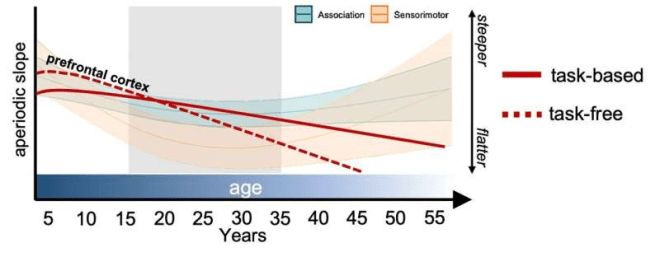
Aperiodic activity reflects neural noise, with flatter slopes indexing increased noise and excitability. Using direct brain recordings in a large sample of neurosurgical patients aged 5-54 years, we discovered that aperiodic slopes in both association and sensorimotor cortices flatten with age into young adulthood. This finding challenges models of early sensorimotor development based on brain structure. In an association region called the prefrontal cortex, attentional state modulates age effects, and age effects explain age-related improvements in memory. Findings establish how aperiodic activity develops in localized brain regions and illuminate the development of prefrontal control during adolescence in the development of attention and memory. Paper published in Nature Human Behaviour.
 dynamic brain lab