
Memory depends on coordination between local processing, indexed by high-frequency broadband (HFB) activity, and global network organization, indexed by theta rhythms. We used direct brain recordings from key regions supporting memory to understand how the results of local processing are communicated through the network. By anchoring analyses of theta phase clustering and connectivity to HFB peaks on a trial-by-trial basis, we discovered how transient brain states linked to internal physiological events support memory. Graph analysis further revealed specific connections amid sparse network connectivity during memory success, challenging the party line that ‘more connectivity is better’. Paper published in PLoS Biology.
Author: Lisa Johnson
new paper on brain networks for executive control
Executive control enables us to compare stored and incoming information in mind, and has traditionally been attributed to the prefrontal cortex. Using scalp EEG, we reveal that individuals with more densely connected frontal midline theta networks are better than others at comparing information in mind. With additional intracranial EEG data, we linked spectral activities to medial frontal, parietal, temporal, and occipital regions. Our results provide new evidence that executive control is not confined to focal prefrontal regions but is instead implemented through coordinated activity across local and large-scale systems. Check out the preprint!
new paper on high-frequency brain activity in infants
High-frequency broadband activity (HFB) tracks local activity from populations of neurons, but has been limited to invasive measures due to signal drop off through the skull. We reveal that HFB measured noninvasively can distinguish wake from sleep states in infants. The presence of both thin skull and soft spots (fontanelles) between skull plates that have not yet fused creates the environment needed for HFB detection in infants using scalp EEG. These results pave the way to study task-related changes in HFB during infancy. Check out the preprint!
new paper on mismatch detection
Our brains compare what we expect to see with what we actually see, helping us spot mistakes – that is, when sensory input is mismatched to our internal prediction. Prior studies identified frontal midline theta activity, with an overlapping N200 ERP, when the brain compares new information with its expectations. Using scalp EEG, we reveal that frontal midline theta supports mismatch detection and explains why some people are better at detecting mismatches than others. However, instead of the N200, we found a slower, positive ERP overlapping with the frontal mismatch response. Findings establish frontal midline theta as a marker of successful mismatch detection, challenge the domain-general role of the N200, and contribute to a growing literature about how we process information. Check out the preprint!
new paper on the development of aperiodic brain activity
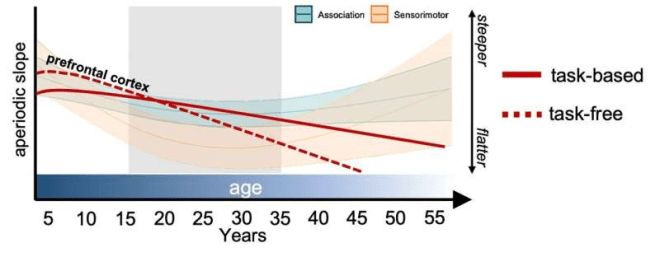
Aperiodic activity reflects neural noise, with flatter slopes indexing increased noise and excitability. Using direct brain recordings in a large sample of neurosurgical patients aged 5-54 years, we discovered that aperiodic slopes in both association and sensorimotor cortices flatten with age into young adulthood. This finding challenges models of early sensorimotor development based on brain structure. In an association region called the prefrontal cortex, attentional state modulates age effects, and age effects explain age-related improvements in memory. Findings establish how aperiodic activity develops in localized brain regions and illuminate the development of prefrontal control during adolescence in the development of attention and memory. Paper published in Nature Human Behaviour.
rainbow for pride month

Happy June!
We proudly support the LGBTQ+ community, promoting inclusivity and celebrating diversity in all its forms. Read more about our mission and values here.
We remain steadfast in our commitment because inclusivity and diversity are essential to progress in science and society.
Dr. Johnson featured on the Scientific Sense podcast
Our research aims to uncover mechanistic explanations of the neural basis of human behavior, that is, move from where to how. Our goals are multifaceted: (1) advance fundamental science by discovering new knowledge using rigorous, reproducible methods; and (2) advance translational applications in neurotechnology, product development, and precision medicine that are grounded in rigorous science. On this podcast, we discuss innovations in understanding how cognition emerges and matures in the developing brain, and how it can be improved in the aging brain.
Watch on YouTube: https://www.youtube.com/watch?v=1vSHPWhUwWY
Listen on Spotify: https://podcasts.apple.com/us/podcast/prof-elizabeth-johnson-of-northwestern-university-on/id1515026470?i=1000708733913
Kathleen awarded summer research fellowship!
Congratulations to undergraduate honors student Kathleen Chen, who was awarded summer research funding!
Joe awarded NSF fellowship!
Congratulations to our PhD student Joe Kelly, who was awarded an NSF Graduate Research Fellowship for his proposal, Establishing neurophysiological signatures of memory in the “medial mystery parietal area” across human development!
new paper on memory reinstatement and transformation

Our memories of events are based on content-specific memory traces. By combining direct brain recordings in neurosurgical patients with deep neural network modeling, we discovered that visual memory traces are reinstated in temporal cortex and transformed in parietal cortex. Findings suggest that reinstatement and transformation together support the creation of generalized and differentiated representations of memory content, thus supporting successful recognition. Paper published in Science Advances.
 dynamic brain lab